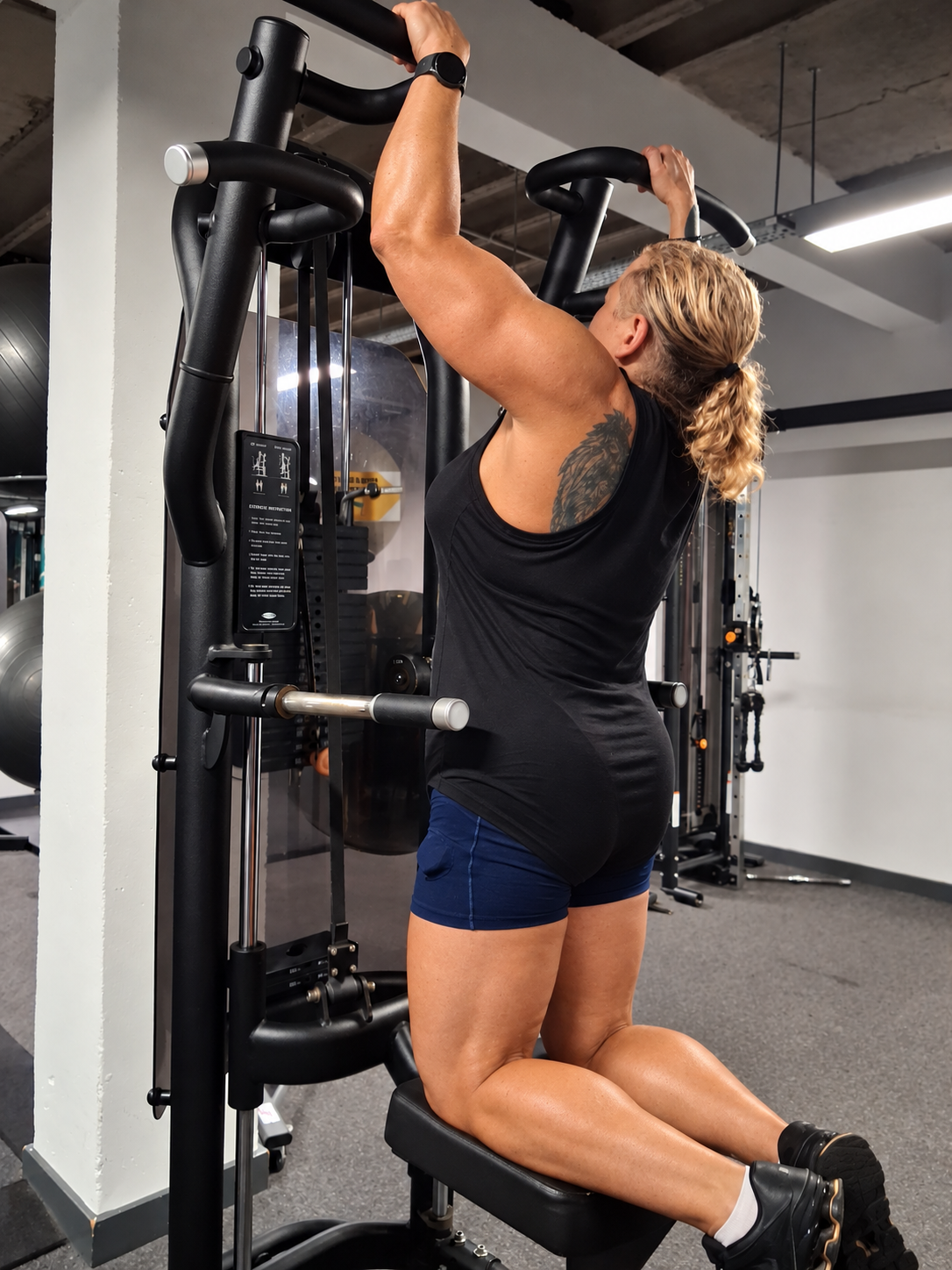
Can 100 repetitions really transform your physique?
One of the biggest questions in strength training is: how much training volume do we actually need to stimulate muscle growth?
German Volume Training (GVT), commonly called the 10×10 method, is known for its demanding workload and straightforward structure: 10 sets of 10 repetitions of the same exercise.
For experienced lifters, it can offer a structured challenge. But does doing more automatically build more muscle? Let's examine how the programme works, what scientific research says, and how to use it intelligently.
01 What Is German Volume Training?
German Volume Training is a high-volume resistance training system popularised by strength coach Charles Poliquin. Historically associated with weightlifting and bodybuilding, it uses repeated sets with moderate resistance.
The classic 10×10 method generally includes:
- Ten working sets of one exercise.
- Ten repetitions per set.
- A relatively consistent training load.
- Controlled technique and adequate recovery.
- Progressive overload over the training block.
For example, 10 sets of 10 barbell squats means completing 100 repetitions of a fundamental lower-body movement.
What is muscle hypertrophy?
Hypertrophy is an increase in skeletal muscle size after appropriate resistance training, nutrition and recovery. Repeated training creates a mechanical stimulus and the body adapts over time.
02 Why Can GVT Stimulate Muscle Growth?
Mechanical tension
Muscles produce force against resistance, creating mechanical loading involved in the signals for muscle adaptation. GVT exposes the working muscles to that loading repeatedly.
High training volume
Volume is often measured as challenging sets for a muscle group over a session or week. GVT deliberately concentrates many sets in a workout. More volume can help up to a point, but more is not infinitely better.
Progressive overload
Overload means increasing the training challenge gradually, whether through resistance, repetitions or better movement quality. The goal is not to barely survive 100 repetitions — it is to improve your performance in a sustainable way.
Muscular endurance and work capacity
Repeated sets can improve tolerance for sustained muscular effort. Remember, though, that soreness, exhaustion and a dramatic muscle pump are not reliable measures of actual growth.
03 The Three-Day German Volume Training Programme
The original example uses three sessions per week with at least one rest day between them, commonly Monday, Wednesday and Friday. It is intended as a short training block of roughly four to six weeks.
Monday — Chest & Back
Superset A: Primary compound lifts
| Exercise | Sets | Reps |
|---|---|---|
| Barbell Bench Press | 10 | 10 |
| Barbell Bent-Over Row | 10 | 10 |
Start around 60% of estimated one-repetition maximum (1RM) where suitable, and alternate between exercises with enough recovery to maintain technique.
Superset B: Accessory lifts
| Exercise | Sets | Reps |
|---|---|---|
| Standing Cable Chest Fly | 3 | 10 |
| Lat Pulldown | 3 | 10 |
Muscles trained: Chest, lats, upper back, biceps and triceps. Maintain shoulder stability on presses, use controlled rows and avoid swinging the weight.
Wednesday — Legs & Abdominals
Superset A: Primary lifts
| Exercise | Sets | Reps |
|---|---|---|
| Barbell Squat | 10 | 10 |
| Lying Leg Curl | 10 | 10 |
Approximately 60% of estimated 1RM is the traditional starting point where appropriate.
Superset B: Accessory lifts
| Exercise | Sets | Reps |
|---|---|---|
| Seated Calf Raise | 3 | 10 |
| Hanging Leg Raise | 3 | 10 |
Muscles trained: Quadriceps, glutes, hamstrings, calves and abdominals. Use a squat depth appropriate for your mobility and maintain spinal control. Ten sets of squats may be unnecessarily fatiguing for some individuals.
Friday — Arms & Shoulders
The original example deliberately uses six repetitions, not ten, for this session.
Superset A: Primary lifts
| Exercise | Sets | Reps |
|---|---|---|
| Close-Grip Bench Press | 10 | 6 |
| Barbell Biceps Curl | 10 | 6 |
Superset B: Accessory lifts
| Exercise | Sets | Reps |
|---|---|---|
| Dumbbell Lateral Raise | 3 | 6 |
| Reverse Dumbbell Fly | 3 | 6 |
Muscles trained: Triceps, biceps and the shoulders. Avoid swinging during curls. For lateral raises and reverse flyes, I would often consider 10–15 controlled repetitions instead of six when that improves comfort and technique — this is my coaching adaptation, not the original programme.
04 How Heavy Should You Lift?
Classic GVT often starts 10×10 compound exercises at approximately 60% of one-repetition maximum (1RM). Your 1RM is the most weight you can lift for a single technically sound repetition.
Example squat 1RM80 kg
Starting percentage60%
Calculated working weight80 × 0.60 = 48 kg
This is a starting estimate, not a target to force. Reduce the load if you cannot preserve your repetition quality or complete the sets safely.
Should every set go to failure?
No. Reaching complete muscular failure on every set is not necessary for hypertrophy. Training to failure too early can reduce the quality of later sets. Begin with several repetitions in reserve and allow later sets to become progressively more challenging.
05 How to Progress Over Four to Six Weeks
The source programme illustrates increases of around two percentage points of 1RM per week:
| Week | Illustrative load |
|---|---|
| Week 1 | 60% of 1RM |
| Week 2 | 62% of 1RM |
| Week 3 | 64% of 1RM |
| Week 4 | 66% of 1RM |
| Week 5 | 68% of 1RM |
| Week 6 | 70% of 1RM |
These are illustrative targets, not compulsory increases. Completing 10×10 at 70% of 1RM may be unrealistic for many lifters, especially when fatigue accumulates.
Repeat the current load or lower the overall workload when technique, performance or recovery decline. After the block, consider a deload period with substantially reduced training stress.
06 Supersets, Rest Periods & Training Quality
A superset means alternating two exercises. For example: bench press → barbell row → rest → repeat, until the intended sets are complete.
GVT does not have to be a fast-paced circuit. The original guide suggests at least 60–90 seconds between sets, extended when needed. Two to three minutes, or longer, can be appropriate for demanding compound lifts.
Take sufficient time for breathing, focus and technique to recover before another challenging set.
07 What Does the Scientific Research Say?
GVT can stimulate muscle growth, but claims that 10 sets automatically produce superior gains are not supported by the available comparative studies.
2017 — Five sets versus ten sets
Amirthalingam and colleagues studied 19 healthy men during six weeks of modified German Volume Training. Both groups trained using either five or ten sets of ten repetitions for selected movements. The ten-set approach did not demonstrate superior muscle growth, while some strength outcomes favoured five sets.
2018 — A twelve-week pilot study
Another small study of 12 healthy men compared modified five-set and ten-set protocols across twelve weeks. Again, ten sets did not show a clear hypertrophy or strength advantage. The small sample means we should not conclude that five sets are always optimal.
2026 — Broader resistance training evidence
The American College of Sports Medicine's 2026 position stand concluded that higher weekly resistance-training volume can improve hypertrophy, but volume needs to be considered alongside individual recovery and programme design.
For many trainees, around ten or more challenging sets per muscle group per week can be useful. This is not the same as doing ten sets of a single exercise during one workout.
Volume also shows diminishing returns: progressively more sets do not guarantee proportionally more growth.
08 Can German Volume Training Help With Fat Loss?
GVT can be physically demanding, but body-fat reduction depends principally on sustained energy balance. No particular set-and-repetition scheme guarantees fat loss.
Resistance training can help preserve muscle during a calorie deficit, making it a useful part of a body-recomposition programme. However, high-volume training combined with aggressive calorie restriction can impair recovery.
For many people focusing on fat loss, a programme with fewer high-quality sets may offer a better balance between muscle retention, performance and recovery.
09 German Volume Training for Women Over 40
Strength training can help maintain muscle, physical function and bone health throughout adulthood, including during perimenopause and menopause. Being over 40 does not automatically make high-volume exercise unsuitable.
Training history, sleep, joint health, current symptoms, movement confidence and ability to recover matter more than age alone.
An experienced lifter might tolerate a short GVT block, while someone returning to the gym may do better with fewer sets and more gradual progression.
10 Nutrition: Fuel Your Training & Recovery
Protein
Protein supplies amino acids used for muscle repair and adaptation. The International Society of Sports Nutrition identifies approximately 1.4–2.0 grams per kilogram of body weight per day as a useful range for many exercising adults, with individual needs varying.
Carbohydrates
Carbohydrates help replenish muscle glycogen, an important fuel source for repeated resistance work. Adequate intake can help support a demanding training block.
Dietary fats
Include suitable dietary fats as part of a varied diet supporting general health and normal physiological function.
Hydration
Fluids support exercise performance and overall health. Needs vary with training duration, environment and individual sweat losses.
Sleep and recovery
Adaptation takes place between sessions. Protect sleep, schedule rest days and adjust training when fatigue accumulates. If you have a medical condition affecting nutrition or exercise tolerance, seek appropriate individual guidance.
11 Who Should Try GVT — and Who Should Modify It?
GVT may suit experienced gym users who have established technique, tolerate high training volume and can dedicate time to recovery. It is generally not my first recommendation for complete beginners or those returning after injury or struggling with persistent joint pain.
A more practical, lower-volume alternative
If you like the structure but do not need the complete ten-set workload, this example offers a more manageable session:
| Exercise | Sets | Reps |
|---|---|---|
| Bench Press | 4–5 | 8–10 |
| Barbell Row | 4–5 | 8–10 |
| Cable Chest Fly | 2–3 | 10–12 |
| Lat Pulldown | 2–3 | 10–12 |
This is a Steph Scully Fitness coaching adaptation, not the original GVT protocol. Exercise choice, weekly frequency and loading should still reflect the individual.
12 Frequently Asked Questions
Is German Volume Training suitable for beginners?
Generally no. Beginners can usually progress with fewer sets while learning sound movement technique and developing consistency.
Is 10×10 better than 3×10?
Not inherently. More sets create more work, but the best workload depends on total weekly volume, effort, technique and recovery.
How long should I use GVT?
The source programme suggests four to six weeks. Longer periods are not automatically more effective, especially if fatigue accumulates.
Will I get stronger?
GVT can improve strength, although programmes with heavier loads and lower repetitions may be more specific for maximal-strength goals.
Can it support weight loss?
It can support muscle retention and body composition, but fat loss still depends on managing overall energy balance.
Must I complete all 100 repetitions?
No. Modify the resistance or volume rather than forcing poor technique to reach a number.
13 My Final Thoughts as a Personal Trainer
German Volume Training is structured, challenging and capable of creating a substantial muscle-building stimulus. But effective coaching looks beyond how difficult a workout feels.
Some individuals thrive on high training volumes. Others achieve excellent results from fewer sets, progressive overload and better recovery. Neither approach is automatically superior for everyone.
At Steph Scully Fitness, I believe in combining exercise science, practical coaching and individualised programming so that your training reflects your goals, lifestyle and experience.
Train with purpose. Progress with consistency. Recover intelligently.
Scientific References & Further Reading
- Richter, D. (2021). The German Volume Training Plan to Build Muscle. StrengthLog. Original programme reference.
- Amirthalingam, T. et al. (2017). Effects of a Modified German Volume Training Program on Muscular Hypertrophy and Strength. Journal of Strength and Conditioning Research, 31(11), 3109–3119.
- Hackett, D. A. et al. (2018). Effects of a 12-Week Modified German Volume Training Program on Muscle Strength and Hypertrophy—A Pilot Study. Sports, 6(1), 7.
- Currier, B. S. et al. (2026). American College of Sports Medicine Position Stand: Resistance Training Prescription for Muscle Function, Hypertrophy, and Physical Performance in Healthy Adults. Medicine & Science in Sports & Exercise, 58(4), 851–872.
- Jäger, R. et al. (2017). International Society of Sports Nutrition Position Stand: Protein and Exercise. Journal of the International Society of Sports Nutrition, 14, 20.
This article provides general fitness education and is not a substitute for individual medical assessment or treatment. Training should be adapted to individual ability and health considerations.